


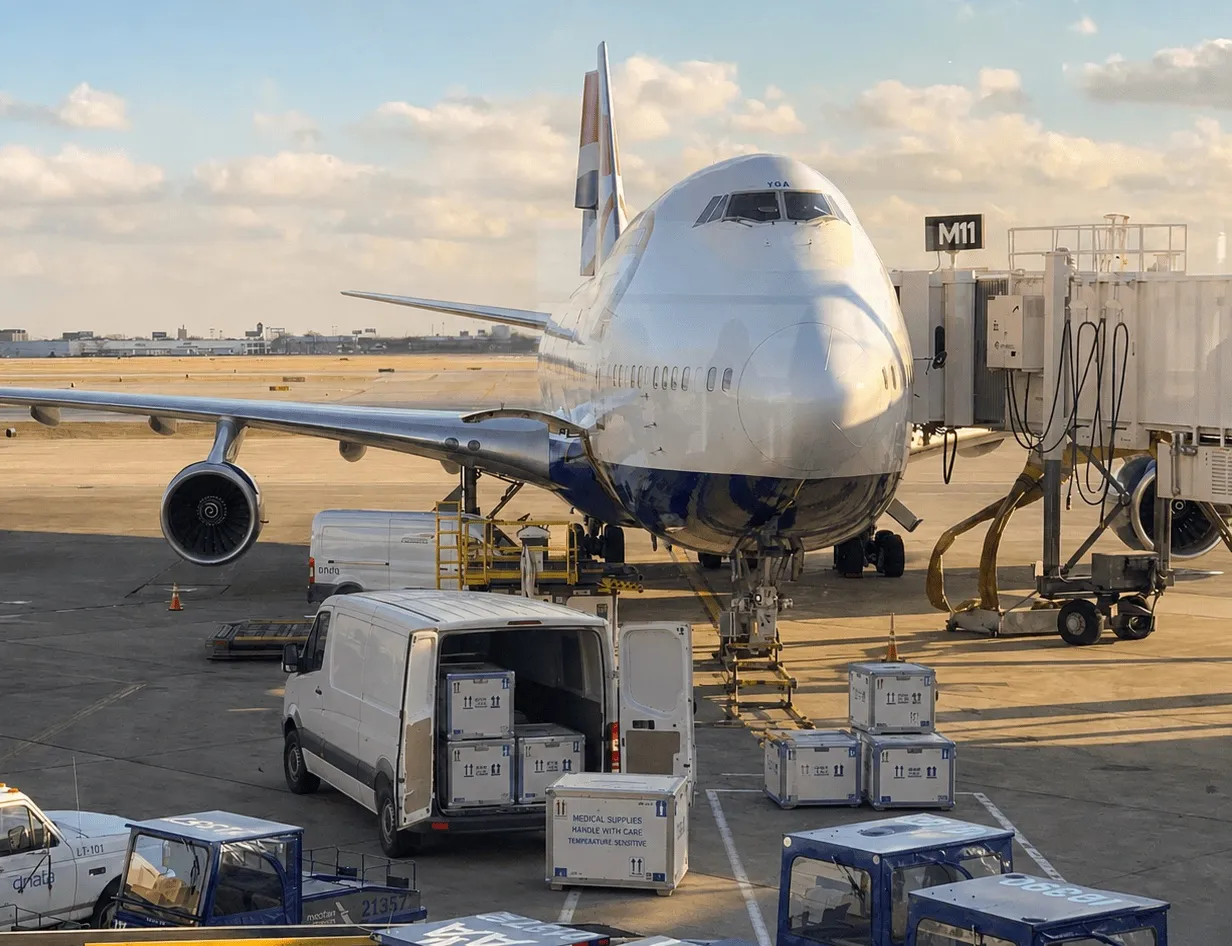
First, why the clock ticks so loudly here. Temperature-controlled airport storage is not ordinary warehousing: it is charged per kilogram per day with a minimum fee per consignment, moving the cargo into the cold room and releasing it out of it are billed separately, and the free period after arrival is measured in hours rather than days. On a few hundred kilograms of medicines, the invoice for two or three days of waiting is large enough that air freight stops feeling fast. So the real objective is not «collect it soon» but collect it before the second storage day begins.
The second decision concerns the type of vehicle. A typical urgent pharma air consignment is one to four pallets and a few hundred kilograms. A twenty-tonne refrigerated trailer makes no sense against that volume: you either wait for one or fill it with other cargo, which costs another day or two. We place a small van with its own refrigeration unit and around one and a half tonnes of capacity. It comes for that specific consignment, waits for nothing to accumulate, crosses the border faster than an articulated truck, and holds the set regime exactly as a large reefer does. The unit is switched on in advance, so the load compartment reaches the terminal already pulled down to the required temperature, whether +2…+8 °C or +15…+25 °C, and the cargo does not warm up during transfer.
Now the twelve hours themselves. This is not on-the-spot heroics but a procedure prepared in advance. Our manager Anna maintains a vetted pool of reefer van operators around Warsaw and Mazovia: vehicles with known qualification, drivers who have carried pharmaceuticals before, rates already agreed. When the flight details come through, the vehicle is booked against the air waybill number and the estimated time of arrival, before the aircraft has landed and before the client has had time to raise a formal order in the usual way. The documentation is prepared in parallel. The result is that at the moment the terminal is ready to release the cargo, the vehicle is already standing there rather than setting off.
We structure the customs side so that nothing is cleared in Poland. The consignment arrives under an air waybill into the terminal's temporary storage facility, then leaves under a T1 transit declaration bound for an inland customs office in Ukraine. We file the import declaration ahead of the vehicle's arrival and book the slot in the electronic border queue as soon as it leaves the terminal. The client covers the regulatory side: importing medicines requires a licence, the consignment is subject to state quality control on entry, and the destination warehouse has to be licensed. Our job is to make sure none of those procedures starts late because a document is missing.
We pick up the cold chain at the terminal itself. The air leg travels either in an active container with its own power supply or in passive thermal packaging with a rated hold time, and in both cases the consignment carries its own record. We place our own calibrated recorders into the van at the moment of loading, so no blind spot remains between the air record and the road record, and hand over the printout together with the cargo. The picture on these trips looks like this: a little over twenty-four hours from touchdown to unloading at the client's warehouse, airport storage either avoided entirely or limited to a single day, and no temperature excursions.