


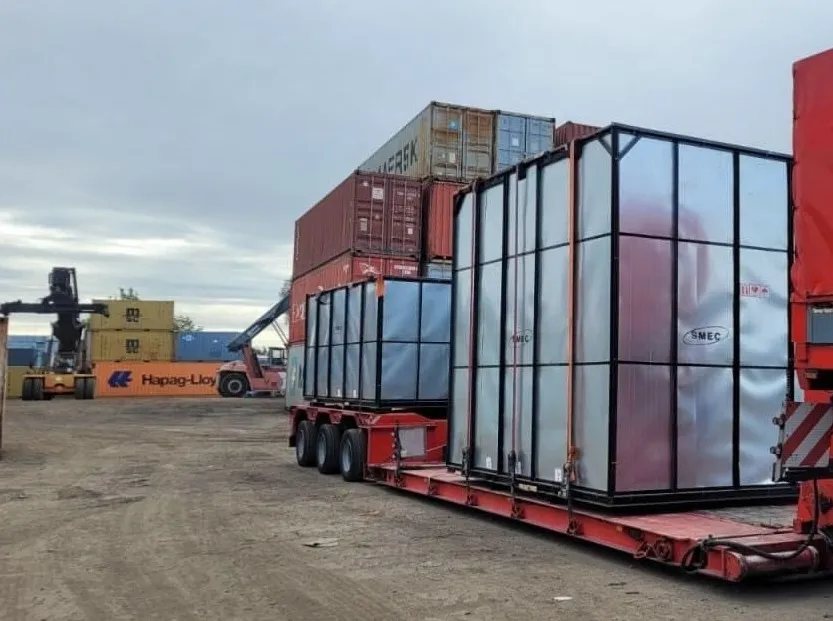
Preparation started with the cargo itself. A power transformer travels empty: the oil is drained at the factory and the tank is filled with nitrogen at slight positive pressure so that no moisture reaches the active part. Radiators, the conservator and the high-voltage bushings come off and are crated separately, and the oil travels on its own shipment in drums. We fitted impact recorders to every transformer tank. For this equipment the danger is not tipping but the jolts from potholes: winding damage is invisible from outside and shows up during testing after installation, by which point proving anything to a haulier is too late.
The trailers were chosen against weight, not dimensions. A transformer is more compact than construction machinery but far heavier, so axle loads and bridge capacity drove the decision rather than the height of the road train. We used four-axle low-bed semi-trailers with extendable frames. The containerised generator sets turned out to be the easy part: they fitted standard parameters and travelled on a parallel shipment with ordinary equipment, no special permits required.
Permits took the longest. In Turkey, a heavy transport permit is issued by Karayolları Genel Müdürlüğü and is tied to a specific route and a specific tractor unit, so swapping a vehicle means a fresh application. Then came the Bulgarian permit from the Road Infrastructure Agency, the Romanian one from CNAIR, and the Ukrainian special permit for the movement of heavy vehicles. The Danube crossing was approved separately: the bridge has its own weight limits, and passage conditions for this kind of mass are agreed well in advance. We began assembling the package three weeks before loading.
The movement was broken into stages tied to site readiness. The client could not receive all the transformers at once: substation foundations were being handed over one by one, and nobody wanted equipment like this standing in an open yard. We dispatched in batches, matching each departure date to the construction schedule. Impact recorder readings were checked at every stop and again at handover, and not one of them had triggered. Crane unloading was planned together with the installation crews before the vehicle even left Turkey.