


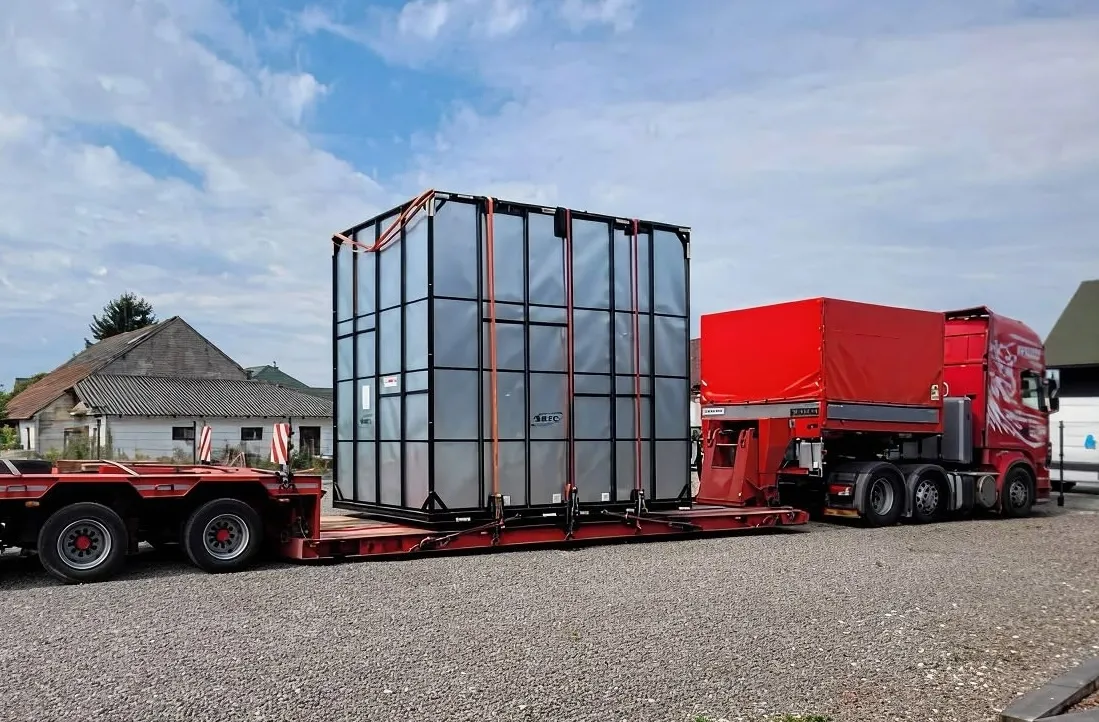
The job did not start with dispatching a vehicle, it started with a survey. We requested exact dimensions and weights from the seller's technical documentation, then verified them on site: on used machinery, actual dimensions often differ from the data sheet because of attachments nobody bothered to remove. Based on the survey we selected a telescopic low-bed semi-trailer with a recessed deck, which brought the overall height of the road train down to a figure that would clear the bridges along the route.
Next came the permits, which is the longest part of the work. In Germany, a movement of this class requires a Großraum- und Schwertransport permit under §29 and §46 StVO, applied for through the VEMAGS system with sign-off from every road authority along the route. In Poland we obtained a permit of the corresponding category, and in Ukraine a special permit for the movement of heavy and oversized vehicles. Route approval ran in parallel, including checks on bridge structures against their design loads and identification of the sections that had to be run at night or under a temporary traffic restriction.
The movement ran with escort vehicles: on the German leg as required by the permit conditions, and on the Ukrainian leg with police escort on designated stretches. Customs was prepared alongside the permits: the machine travelled under a T1 transit declaration to an inland customs office rather than being cleared at the border, so the oversized road train would not be held at the crossing point. The document package covered the CMR, invoice, technical documentation for the machine, a weight and dimensions certificate and the cargo securing plan.
The equipment reached the client's site undamaged and on the agreed date. Unloading was planned in advance together with the client: a crane was selected against the tonnage, and the approach to the unloading point was checked for clearance back at the route approval stage, so the road train would not run into an impossible turn two hundred metres from its destination.