


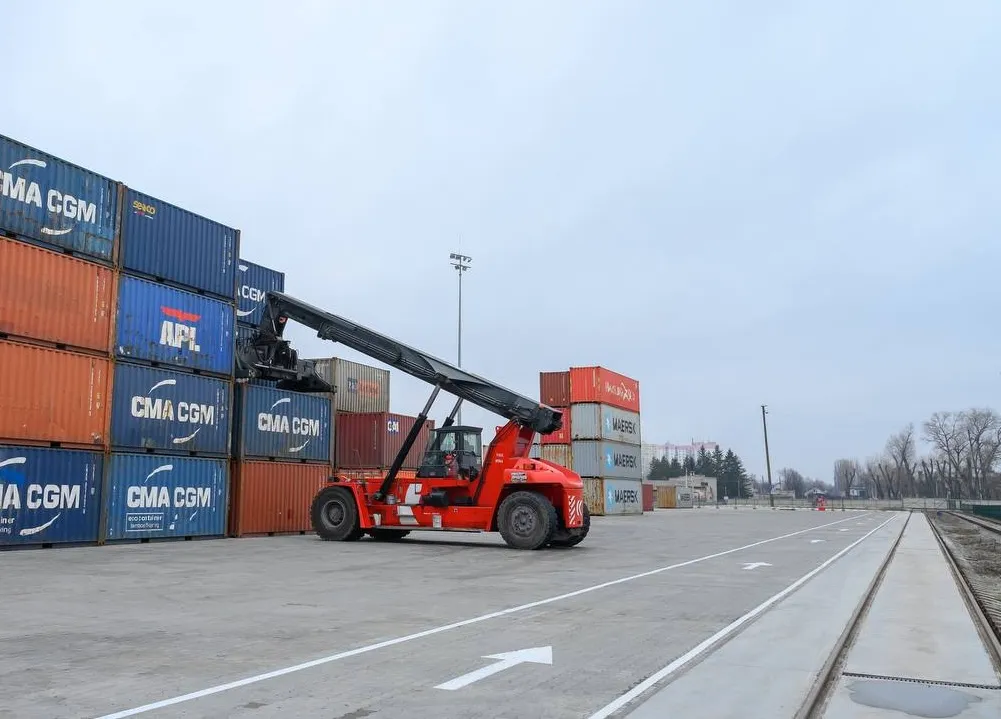
We proposed moving the grain not in bulk but in 20-foot containers fitted with liner bags: a heavy polypropylene bag is installed inside the container and the grain is loaded straight into it. A 20-foot container rather than a 40-foot one, because here the limiting factor is weight, not volume: grain hits the weight limit long before it fills a forty-footer. This format turns grain into ordinary container cargo that can go on any container vessel and sail to any market.
We then assembled these containers into a block train: a full trainset that runs from the departure station to the port as a single unit, without being broken up and re-marshalled at sorting yards. That is what gives a block train its main advantage: it moves to a timetable and predictably, rather than sitting in queues to be re-formed. For regular exports this is critical, because the trader can plan vessel arrivals against specific dates.
We ran the route to the port of Gdansk on the Baltic. At the Ukrainian-Polish border the containers were transferred from broad gauge (1,520 mm) onto standard gauge (1,435 mm): for containerised cargo this is a routine crane operation, which we built into the schedule in advance. In Gdansk the containers were lifted off the train onto the deep-sea terminal, from where the grain sailed on ocean lines to markets in North Africa, the Middle East and Asia, the very same destinations it used to reach by sea from the Black Sea.
We standardised the documentary side for the client: a rail consignment note for the leg to the port, a phytosanitary certificate, quality and origin certificates, and port and export declarations. The proven template let us run subsequent block trains on the same pattern, with no hold-ups at the border or in port. The result was a stable overland export channel that did not depend on the situation in the Black Sea and gave a predictable rhythm of shipments.